City of Ottawa and feds partner to build 3,000 new affordable housing units
and the City of Ottawa have partnered to accelerate the construction of up to 3,000
, with the goal of breaking ground next year.
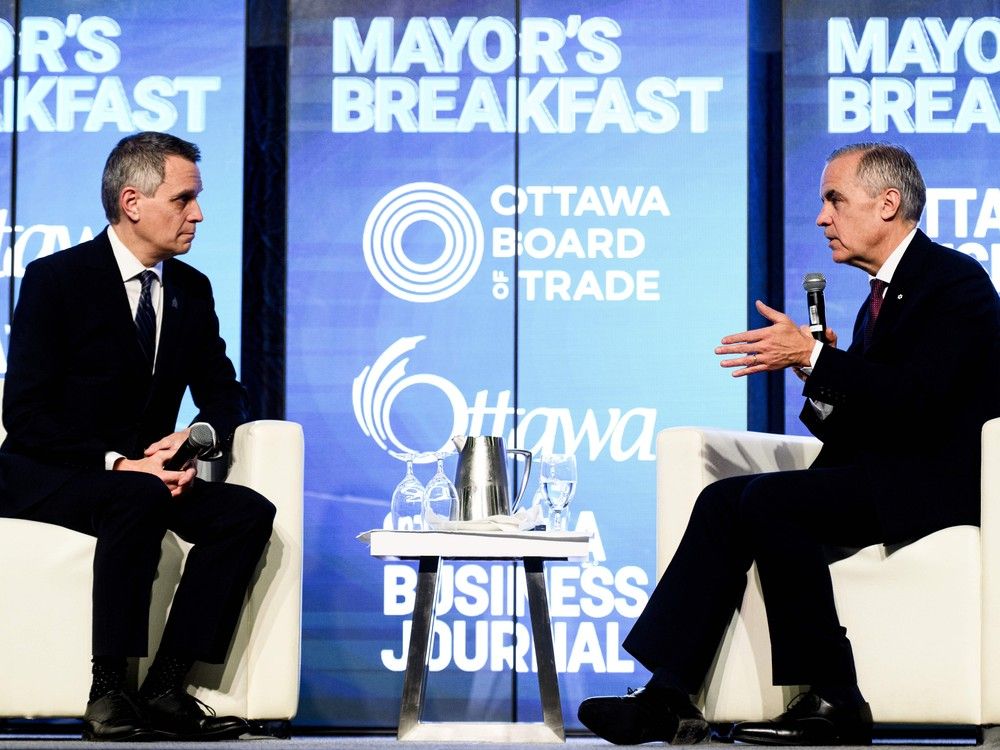
Prime Minister Mark Carney announced the partnership at
breakfast series early Monday morning, along with a joint investment of $400 million.
Under the agreement, the City of Ottawa also promised to reduce or waive development charges, permit fees and property taxes on “priority projects” for 2,000 new housing units.
Build Canada Homes, a new federal agency that will oversee the construction of
, will also help finance an additional 1,000 non-market housing units in the city’s portfolio.
“By fast-tracking approvals, streamlining permitting and development, building faster on federal and municipal lands, and attracting private capital, this partnership is a model for how to build across this country,” Carney told the crowd in a packed room inside the Rogers Centre.
Sutcliffe lauded the announcement and said it aligns with the city’s Housing Action Plan, which was approved in October.
“It’s a big deal, and I’m proud to be the first city to sign a deal like this with Build Canada Homes. We want to lead the way on housing,” Sutcliffe told journalists after the event.
“Our Housing Action Plan has been called the most ambitious in Canadian history at the municipal level. We’re saying yes to housing. We want to be the most housing-friendly city in the country, so this is a giant step towards that.”
But Sutcliffe didn’t provide details about where these affordable units will be built, only that they will be constructed on federal land. The mayor also didn’t provide details about what type of units will be built and whether they will include family-oriented units.
A detailed report outlining the next steps and where crews will be breaking ground will be published next year, he said, but didn’t specify a date or a timeline.
“If you think about all the federal land that we have in our city, there’s a huge opportunity to take that land and, instead of it sitting empty, to turn it into affordable housing,” Sutcliffe added.
“It’s not a cost (to taxpayers). It’s an investment. It’s an investment in affordable housing, and it’s an investment in creating homes that will then be part of our community, where nothing exists right now. It’s a no-lose proposition for the City of Ottawa.”
The City of Ottawa also announced on Monday afternoon that it will be partnering with the Ontario government and Habitat for Humanity to build 33 new townhomes at 40 Beechcliffe St., which was earmarked for affordable housing in April after the city declared it as surplus land. It is part of the Ontario-Ottawa New Deal to construct affordable modular homes on surplus land.
According to a news release, the home prices will “reflect prices home buyers can afford.” The homes will be family oriented and will not require a down payment, the province added. Mortgage payments will also be geared toward household income.
Monday’s announcement comes as housing prices in Ottawa rose in the third quarter of 2025.
Data from The Canadian Real Estate Association showed that the median price of single-detached homes in Ottawa rose by 1.9 per cent year-over-year to $790,000 in the third quarter of 2025. The median price of townhomes rose by 1.7 per cent year-over-year to $570,000, while the median prices of condos were down by 5.2 per cent year-over-year to $378,500 in the same time period.
Rent prices in Ottawa are also unaffordable, despite holding steady year-over-year. Data from Rentals.ca suggested that the average rent for a one-bedroom apartment in October 2025 was hovering at around $1,971 a month, a 3.2 per cent decrease year-over-year. The average rent for a two-bedroom apartment was around $2,523 a month during the same time period, a 1.4 per cent increase.
Earlier this year, the 2024 Housing Needs Assessment report said the proportion of homeowners in Ottawa paying $2,000 or more per month for housing costs nearly tripled from 2006 to 2021.
Thousands of Ottawans are also in core housing need (CHN), the report added. CHN is said to be a key measure of housing instability, identifying households that lack adequate, suitable and affordable housing without access to alternatives in their local market. It is also a measure of heightened vulnerability within the housing market, as many residents are spending well beyond affordability thresholds.
According to the 2024 Housing Needs Assessment, there were 92,895 people in CHN in Ottawa in 2021. Most of them were people aged 25 to 35, children and youth aged 0 to 17 years, and seniors aged 65 years and over.