

Critics blast $26M budget boost for Ottawa police

Critics blasted a proposed $26-million budget boost for Ottawa police as community advocates and anti-racism activists said the money would be better spent on alternative responses to mental health calls and to those involving Black and Indigenous people.
Sam Hersh of the Horizon Ottawa community advocacy group spoke to the Ottawa Police Services Board on Friday and pointed to the success of the Alternate Neighbourhood Crisis Response (ANCHOR) program in handling mental health crisis calls that would have otherwise been directed to police.
Launched in August 2024, ANCHOR handled 4,464 calls in its first year of operations, with the majority (about 93 per cent) of those calls placed directly to its 2-1-1 crisis line.
The remaining seven per cent (262 calls) were transferred to ANCHOR from Ottawa police emergency lines, according to a one-year update to council that will be tabled at the Nov. 25 community services committee.
Hersh said the program, “though limited and still with too much police involvement, (has) shown what is possible when we focus on a non-police response to mental health calls, but its mandate must be expanded.”
ANCHOR operated solely in Centretown during its first year, with its boundaries set to expand westward to Island Park Drive and south to Carling Avenue, extending into the catchment area for the Somerset West Community Health Centre.
The ANCHOR program is set to receive $700,000 next year, according to the city’s draft budget, which critics have contrasted with the $26 million that the Ottawa Police Service will receive with its largest budget increase in a decade.
“This is why the $26-million increase shouldn’t be approved, and why some funding from that increase should be redirected toward real alternatives,” Hersh told the OPSB on Friday. “The police budget frames mental health calls as a major driver of workload and therefore uses them to justify increased spending.”
Since mental health calls make up a significant portion of police responses, Hersh said, the solution is not to increase spending on police, but rather to reduce police involvement through community-led, non-policing interventions.
“Proper funding for ANCHOR would allow it to operate citywide, remove the restrictive violent and non-violent triage model that still informs police in many calls … and ensure that calls involving Black, Indigenous, disabled and unhoused residents are met with care rather than enforcement.”
Hersh called for the ANCHOR program to expand into other wards like Rideau-Vanier and the Herongate neighbourhood “to build more independent, non-police mental health crisis response and to ensure that the police step back from mental health calls rather than using those calls as a justification for endless budget growth.”
Police Chief Eric Stubbs told council the budget increase, which will be funded largely through a five-per-cent increase to the property tax levy, was necessary to cover the service’s new district policing model, rising salaries, benefits and sick leave, new body-worn cameras and 25 new hires planned for next year.
Robin Browne of the anti-racism group 613-819 Black Hub said the city demonstrated a “double standard” by introducing an “austerity budget” that capped increases at 2.9 per cent for most city departments, “but that doesn’t apply to police.”
A large majority of the police service budget (85 per cent) will be spent on compensation, with eight per cent going to materials, supplies and services, four per cent to capital budget and debt and three per cent to capital chargeback expenses like the radio system.
“Most of this increase is to pay for salary increases, and their own data continues to show that they continue to use force disproportionately on Black and Middle Eastern people,” Browne said.
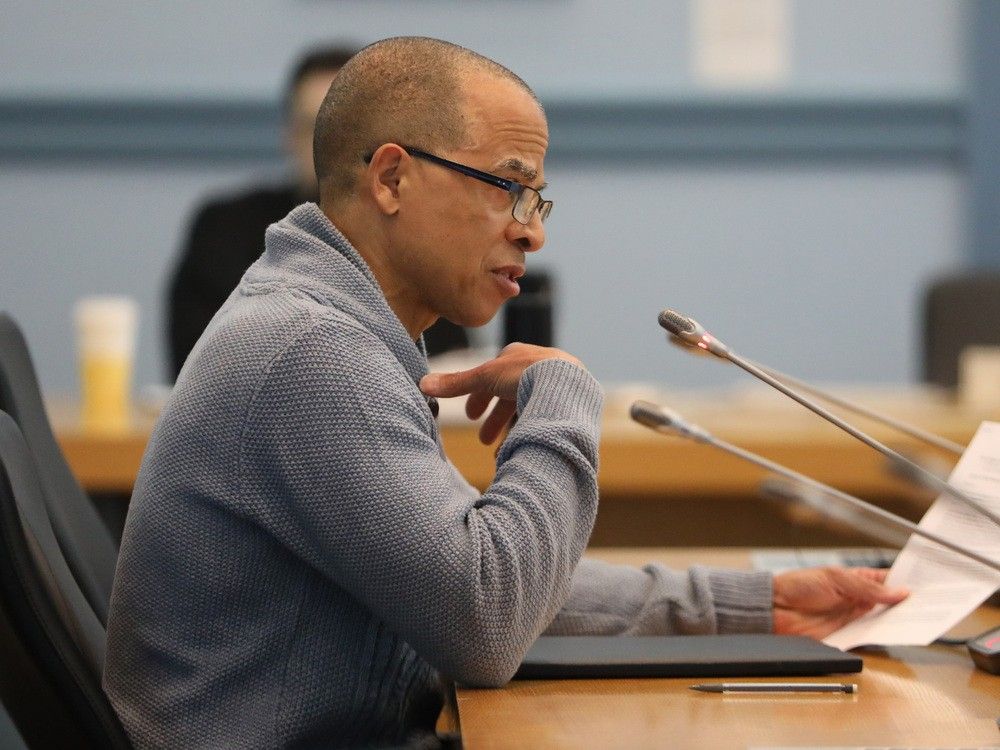
Browne was also critical of the OPS pilot program outfitting 30 officers on its crisis intervention team with body-worn cameras, he said, “despite all the evidence that shows that doesn’t reduce police violence.”
The board heard one delegation from the Chinatown business community Friday that supported the budget increase and called for heightened police presence and visibility in the community.
“Increased resources are necessary to ensure effective neighborhood policing, community patrols and programs that directly improve safety in high density areas such as Chinatown,” said Yukang Li, executive director of the Chinatown Business Improvement Area.
“Community officers are currently stretched very thin, covering multiple areas and unable to fully respond to community needs. We respectfully ask for increased staffing for the officers assigned to Chinatown so they can provide consistent proactive engagement and support,” said Li, who also called for security cameras, lighting, signage and other community safety initiatives.
He said a community policing office or a satellite post in Chinatown had been a “longstanding” request from the business community.
“These investments are critical in a busy commercial district and help prevent incidents while reassuring residents, visitors and businesses,” Li said.

Coun. Marty Carr, who serves as OPSB vice-chair, said the Somerset ward had seen a 19-per-cent spike in violent crime over the same period in 2024.
Some critics have pointed to the provincial government’s decision to close a supervised drug consumption site at the Somerset West Community Health Centre as a contributing factor to the increase in crime.
“I totally empathize with what they’re feeling,” Browne said. “The problem is it’s the knee-jerk reaction of, ‘Hey, let’s get more police.’ And, again, all the evidence shows that won’t work.
“You’d need a cop on every corner, and that doesn’t address the root problem. Throwing money at the (OPS) isn’t going to address problems with addiction, and in fact, it makes things worse because it’s taking money away from the things that would address the root problems, like addiction services, housing and mental health supports.”
Our website is your destination for up-to-the-minute news, so make sure to bookmark our homepage and sign up for our newsletters so we can keep you informed.
